
Enforcement
Visible and effective enforcement sends a clear signal that harassment is unacceptable
Redbridge was the first London borough to enact a Public Space Protection Order (PSPO) against street harassment.
The Public Space Protection Order (PSPO)
Redbridge was the first London borough to set up a PSPO specifically targeting harassment. The PSPO covers the whole borough and includes clauses prohibiting any behaviour which could ‘cause harassment, alarm or distress.’
While the new sexual harassment bill is now enforceable by the police, the PSPO serves as an additional layer of enforcement, giving council enforcement officers powers that they would not necessarily have under the national legal framework.
The PSPO provides a valuable tool for holding perpetrators to account. It enables council enforcement teams and police officers to hand out fixed penalty notices. This ability to act directly meant the PSPO could have an immediate impact in a particular situation and stop the problem behaviour.
The language in the order is not gendered so anyone can be the victim and anyone over 18 can be a perpetrator.
How it was set up
There is a set legal process for implementing any PSPO and this process was followed for the borough-wide PSPO to prohibit sexual harassment. As part of the process, you must provide evidence that the behaviour you are prohibiting is an issue significant enough that it requires additional local legislation. You must also show that it is not a short term issue and that without changing local legislation the problem is likely to remain.
We did receive some challenges from some freedom of speech activists who requested all our evidence and reasoning for implementing the PSPO. This then went no further.
Practicalities
Practical processes will vary from borough to borough; in Redbridge it is dependant on our local constitution. This treats the PSPO as a key decision for which 30 days’ notice must be given on our website. This means that the decision can be called in by cabinet, if required.
Most of the legwork was done by the community safety and legal teams, but since we wanted to consult widely, we worked with other teams to distribute and promote the surveys.
From start to finish the process typically takes around three months depending on available evidence, the level of public engagement needed, legal capacity and, of course, political and senior leadership support.


How has it helped?
The PSPO enables us to fine offenders, so without it there would be no enforcement mechanism to stop offenders from harassing people in the street.
This has had the effect of stopping offenders whose behaviour may otherwise escalate. On multiple occasions officers in the process of giving a fine have then had to escalate their action due to the behaviour of a perpetrator.
To be able to make a stand against harassment it is vital to have a clear enforcement action that can be undertaken by council enforcement officers as well as the police. This enables a zero-tolerance approach to harassment that would not otherwise be possible.
We can’t arrest our way out of this problem. We need to use every available angle. We need the whole community involved, so each person can step in and make a difference.’
Clare McCarthy, Superintendent, Neighbourhood Policing, London Borough of Redbridge, East Area
_
‘
An effective collaboration with local police
This Has To Stop is driven by cross-partnership working; to make meaningful systemic change all parts of the system must buy in. This is why the different phases focus on different target audiences and service areas.
The first stage, which we dubbed ‘It’s the law’ focussed on our Public Space Protection Order and work with the police to enforce against sexual harassment in the streets. It put the focus on perpetrators.
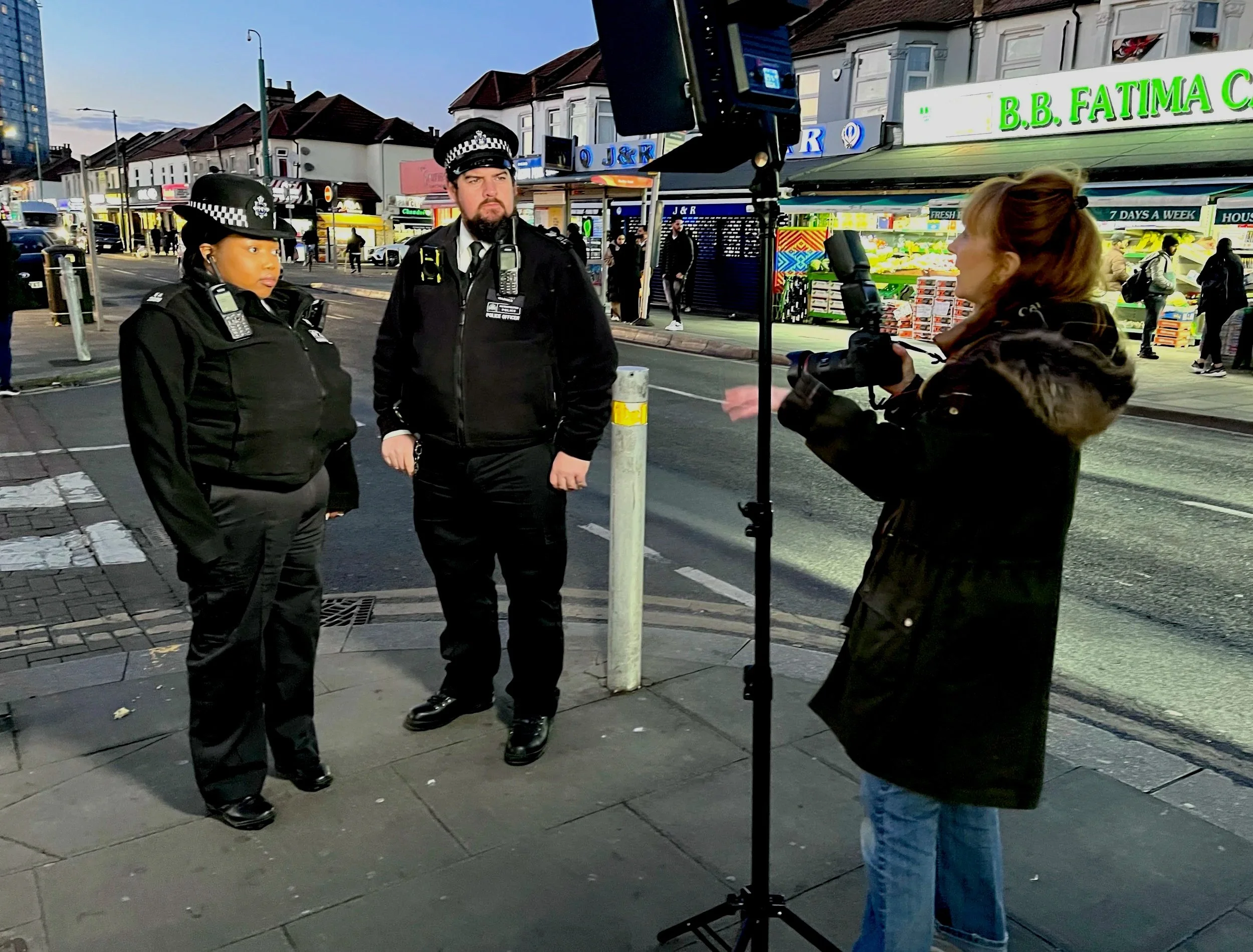
Local Redbridge police officers modelling for the poster campaign.
‘This isn’t a problem we can arrest our way out of.’ Superintendent Clare McCarthy describes how involvement in Redbridge's ThisHasToSTOP campaign helped to cut sexist harassment twice as fast as what was achieved in surrounding areas.
New legislation supports enforcement – but it’s still worth having a PSPO
The Protection from Sex-based Harassment in Public Act received Royal Assent in 2023 and came into full operational effect in mid-2026 once the sentencing guidelines were finalised.
This new law recognises offences based on the victim’s sex, or presumed sex, extending the existing offence of ‘causing intentional harassment, alarm or distress’ (Section 4A of the Public Order Act, 1986). The new offence allows a sentence of up to two years in prison.
While very welcome, because it gives police specific powers to tackle misogynistic harassment, the legislation it doesn’t remove the value of having a localised PSPO, such as the one operating in Redbridge.
One of the advantages of a PSPO is that it empowers civilian staff to intervene and issue fines. This makes the PSPO a tool for stepping in early, so everyday acts of harassment are nipped in the bud before they escalate into criminal offences.
A PSPO means that Council Enforcement Officers, town centre security staff and other local officials are empowered to tackle the seemingly-small but insidious acts that blight the lives of women and girls in our communities, while helping to challenge a culture in which sexist behaviours have been normalised.
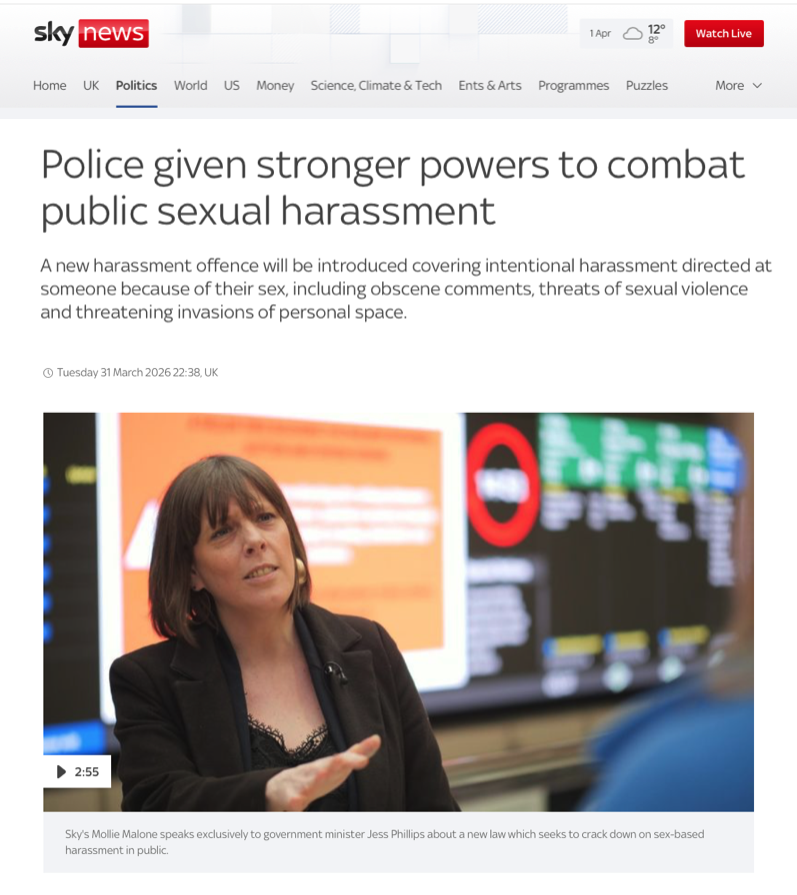
A Sky News article about the new police powers to combat harassment.