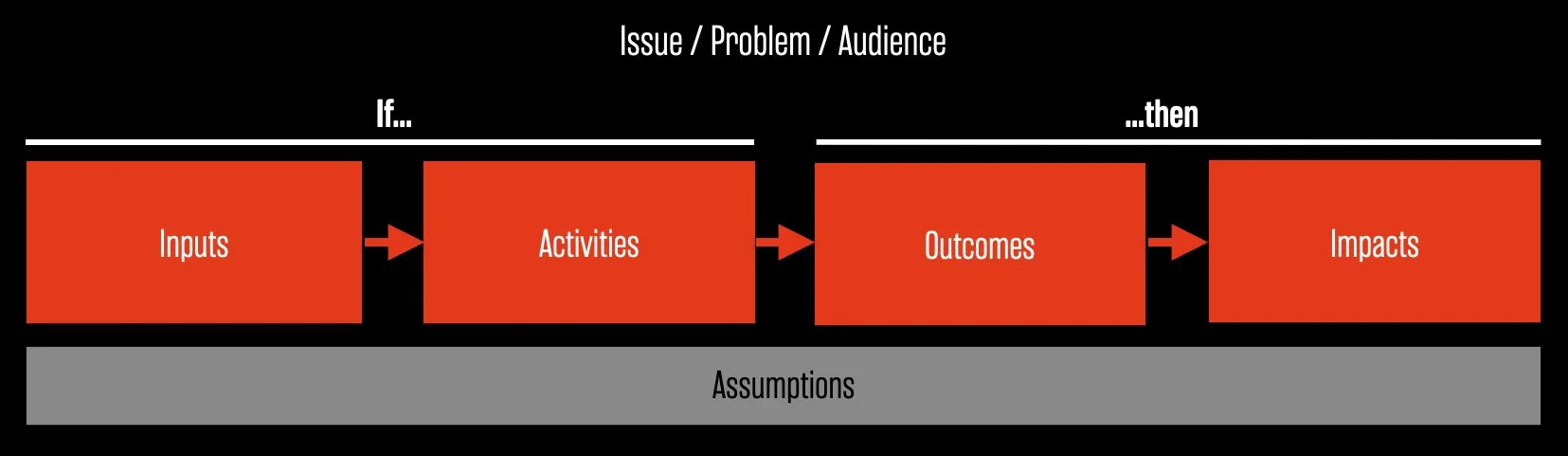
A theory of change
A successful VAWG programme targets key audiences in specific ways
In the past, initiatives tended to focus on empowering women to survive in a hostile environment. But this fails to tackle the root of the problem and places an unfair burden on victims rather than perpetrators.
In Redbridge we wanted to get to the heart of the issue by tackling the larger problem of perpetrators.
We needed to empower local communities to create long-term cultural change, which is why ThisHasToSTOP includes several different strands that require quite distinct approaches. It was our job to understand the barriers and opportunities to this engagement.
When planning our approach, we considered some of the factors that shape human behaviour. We reviewed research and information about the local population to get a better understanding of the lives and lifestyles of residents, asking questions like: ‘What makes them tick? What influences their decision-making? What drives unacceptable activity and what would it take to get them to adopt pro-social behaviours?’
We concluded that the Theory of Planned Behaviour provides a useful framework to consider how and when to intervene. ‘There’s many a slip between cup and lip’, as the saying goes, and so it’s true for local residents – sometimes good intentions aren’t acted upon; something gets in the way and the opportunity passes by.
The Theory of Planned Behaviour provides a useful framework to consider how and when to intervene.
_
‘
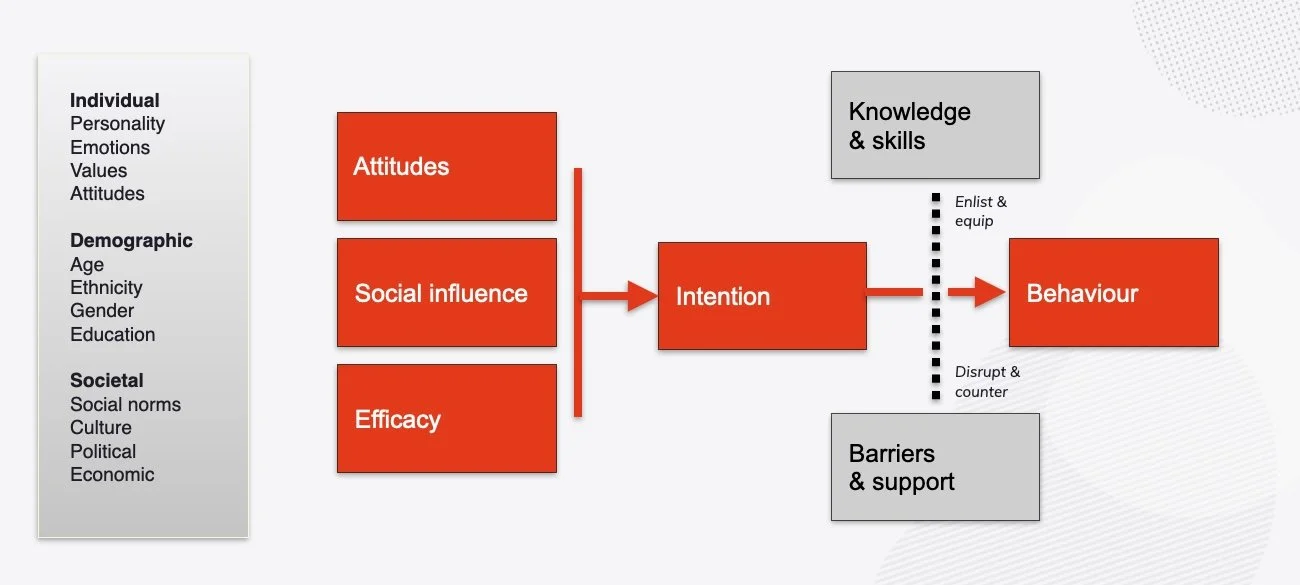
The Theory of Planned Behaviour (Ajzen, 11987)
The ThisHasToSTOP model
ThisHasToSTOP adapts and simplifies the Theory of Planned Behaviour into a roadmap for effective VAWG intervention in a specific locality or community, typically at the borough or local council level.
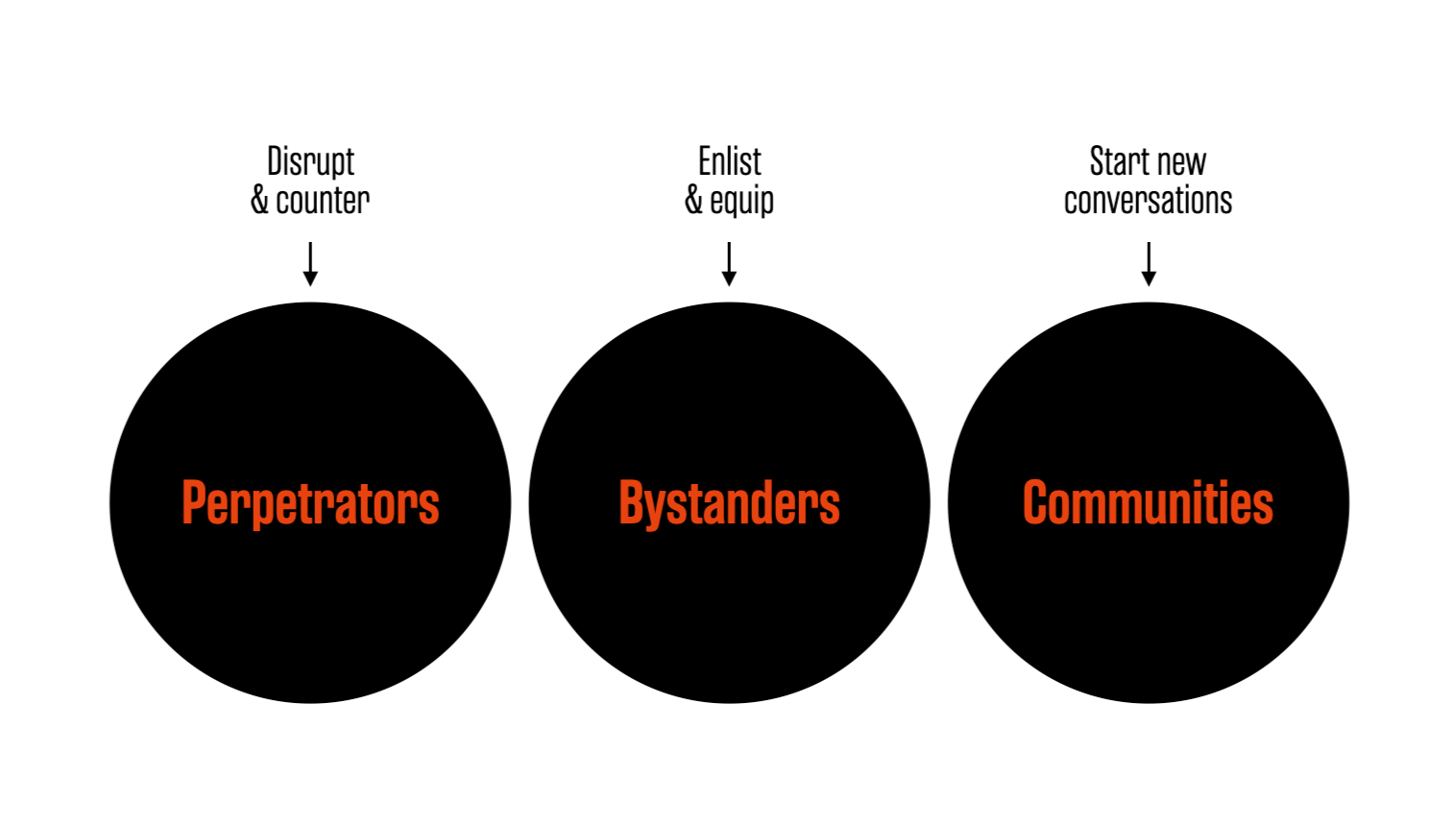
The model targets key stakeholder groups with a series of actions designed to achieve progress towards genuine culture change.
Social norms
Of course, most people don’t go out of their way to be misogynists, but we know that it is embedded in many of our inherited cultural assumptions.
Social norms are deeply ingrained and can serve as tacit endorsement of low-level sexism which, in turn, can provide a breeding ground for unacceptable and even violent behaviour. A culture that tolerates everyday sexist norms, such as discriminatory language, jokes, or cat-calling, provides a level of social acceptability that can escalate to unwanted interactions and worse.
Perpetrators
Disrupt & counter
We need to show perpetrators that sexist harassment, which has become normalised in our culture, is no longer acceptable.
So those people already displaying unacceptable behaviour require a more directive approach – one that disrupts their activities and counters the received narrative (perhaps even an internal narrative) that leads them to feel that sexist behaviours are OK.
In concert with ThisHasToStop, Redbridge developed a highly effective and targeted Public Space Protection Order (PSPO), which made low level sexist harassment a punishable offence. This gave us a powerful ‘line in the sand’ that was both enforceable and enabled us to shift cultural assumptions about acceptability.
Bystanders
Enlist and equip
The good news is that people in our communities can be an untapped resource in shifting the culture. Our goal is to enlist these people, help them to identify misogyny and equip them to become active bystanders – people who understand when and how to intervene when they see misogynistic behaviours taking place.
But many people lack the confidence about what to do or how or when to speak up. Our mission is to ‘enlist and equip’ these potential changemakers, providing the tools and skills they need to help close the gap between intention and behaviour. So part of our job is to create practical interventions that will stimulate new conversations, shift mindsets and to increase people’s confidence to step in as active bystanders.
Communities
Create new conversations
Our active bystanders are the leading edge of driving change in our communities, but we can also help to shift the conversation at the community level. Providing people with key concepts, such as harassment and misogyny can change the cultural conversation and help shift social norms.
Education has a key role to play here, so providing materials for schools so that students can develop a deeper understanding of the dynamics of sexism and how it affects them can lay a foundation for safer communities in future.
A Theory of Change
The process of thinking about the various factors that influence people’s lives and behaviours, along with the opportunities to intervene, brings a more nuanced understanding of our target audiences and the ways to reach them.
As providers, this thought process enables us to set out ambitious goals and to plot the route to achieve them. That’s where a theory of change, or logic model, can really help. Your theory of change sets out the actions to take to achieve success, grounded in the context of your community.