Councils
Welcome
Councils can have a transformative impact on women’s safety and domestic abuse – issues of major public concern – by taking a proactive and preventative approach, guided by behavioural science. That’s where ThisHasToSTOP comes in.
This page provides an overview of what’s available, including some of the ways you can use ThisHasToSTOP Toolkit to build a business case and create lasting change in your community.
What do you want to do?
-
Step In for Schools includes a full spiral curriculum for:
Primary (Year 6)
Transition to Secondary
Secondary (Years 7-9).
This comes with a teacher’s pack, letters for parents and even a certificate of achievement for students who take part.
-
Sometimes it’s useful to start small. Our Taster session is designed to be used in assemblies or other pastoral settings in school.
The session includes full slide deck, AV materials and teacher’s guidance.
-
Step In - Bystander training includes an easy to run 30 minute workshop that gives participants a tried and tested way to step in safely when they see someone being harassed.
There are loads of extras to access too, including a printable enamel pin badge, a poster, a digital poster and Three ways to Step In memory card for your wallet.
-
ThisHasToSTOP and Step In are both based on evidence-based behavioural science research and have been co-created with people from the community.
-
We know the pressures on your time. There’s a limit on what you can fit in to your teaching, too. But what could be more worthwhile than an engaging and transformative classroom experience, particularly one that addresses vital issues such as misogyny and harassment?
We’ve got all the details that Heads will need to understand the value of adding Step In to your school.
The business case for council-led VAWG prevention
The ThisHasToSTOP toolkit exists to prevent sexual violence - by changing attitudes and behaviours among potential perpetrators, bystanders and the wider community.
Councils have a statutory requirement to provide domestic abuse services and carry a significant share of the financial burden created by violence against women and girls. Government figures put the cost of domestic abuse at £66 billion a year, affecting 2.4 million victims annually. Much of this cost falls on local authorities through social care, housing and children's services. Most council spending on this issue happens after harm has already occurred, on emergency accommodation, social care, support services and staff time. This is expensive, and it does not stop the problem recurring. Prevention work turns off the tap. It reduces the number of people who need these services in the first place, rather than managing an ever-growing flow of demand.
Sexual harassment, gender-based violence and domestic abuse are inextricably linked. They are driven by the same root causes: gender inequality and a tolerance of disrespectful behaviour towards women. The evidence shows that increasing gender equality and promoting equal, respectful relationships reduces harassment and abuse over time. This means that work that challenges harassment and promotes equal, respectful relationships helps prevent domestic abuse as well. The toolkit can help stop behaviours escalating to the point where council intervention and support become necessary. The question for councils is not whether to spend money on this issue – the question is whether it is spent on prevention, or on the consequences.
Government figures put the cost of domestic abuse at £66 billion annually, affecting 2.4 million victims a year.
_
‘
Benefits go beyond preventing domestic abuse – residents who feel safe in their town centres, workplaces, schools and public spaces are more likely to use them. Visible council action on harassment signals to women and girls that the council takes their safety seriously. This supports the local economy by increasing footfall on local high streets, and builds trust in the council itself.
Prevention work does not require a large new budget line or a lengthy procurement process. There are practical, low-cost ways to start - our resources are available free of charge. Many of them, including table talkers, bystander intervention workshops and our schools programme, can be implemented immediately. A free support consultation call is available to explore what prevention work would look like in your local context.
Councils are already carrying the financial and human cost of harassment and abuse. Prevention is one of the few levers available that reduces this cost over time, rather than simply managing it – being proactive rather than reactive.
Sexual harassment, gender-based violence and domestic abuse are inextricably linked.
_
‘
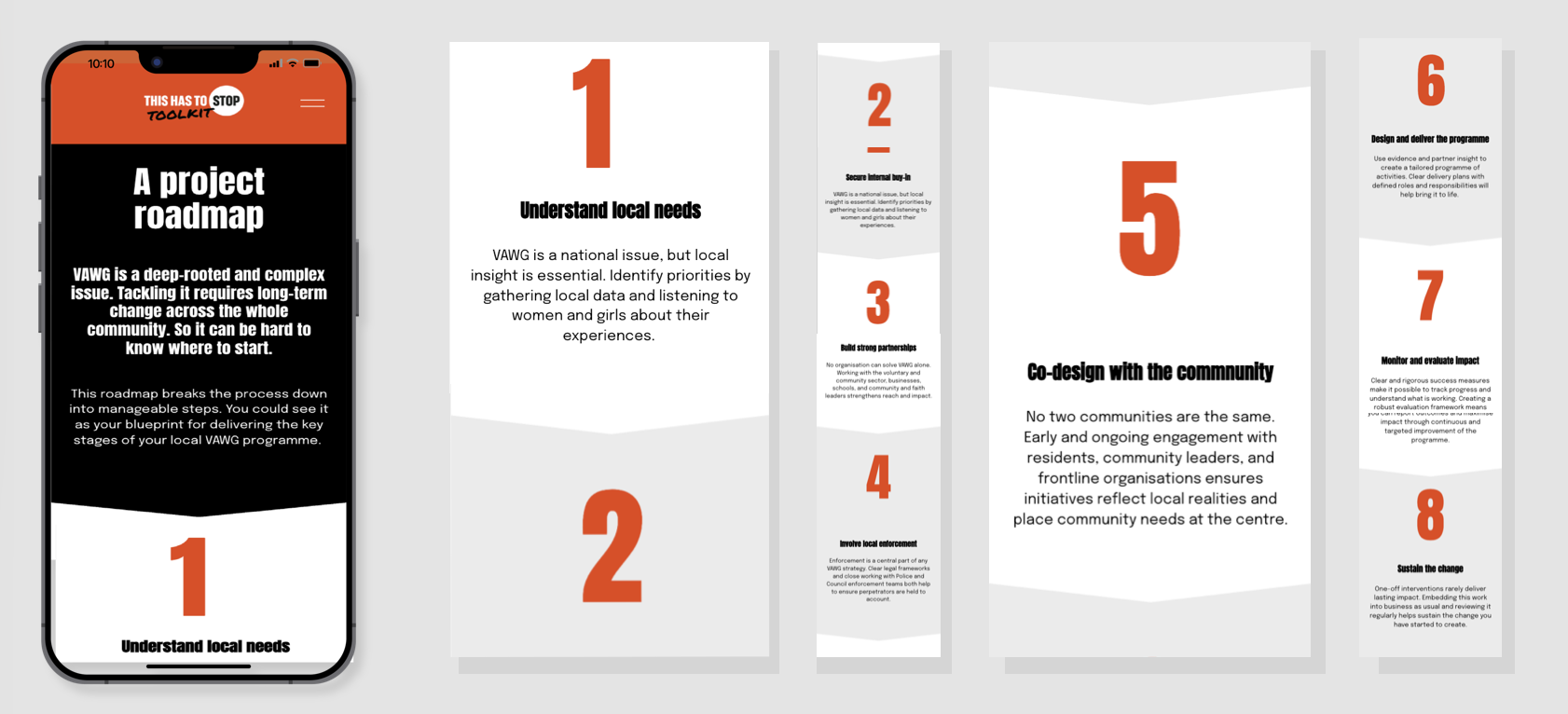
We’ve created a project roadmap for Councils
Effective change requires long-term planning and commitment, so the ThisHasToSTOP project roadmap breaks the process down into manageable steps, serving as a blueprint for delivering a local VAWG programme.